Showing posts with label mural. Show all posts

Thursday, December 15, 2011

Dragons

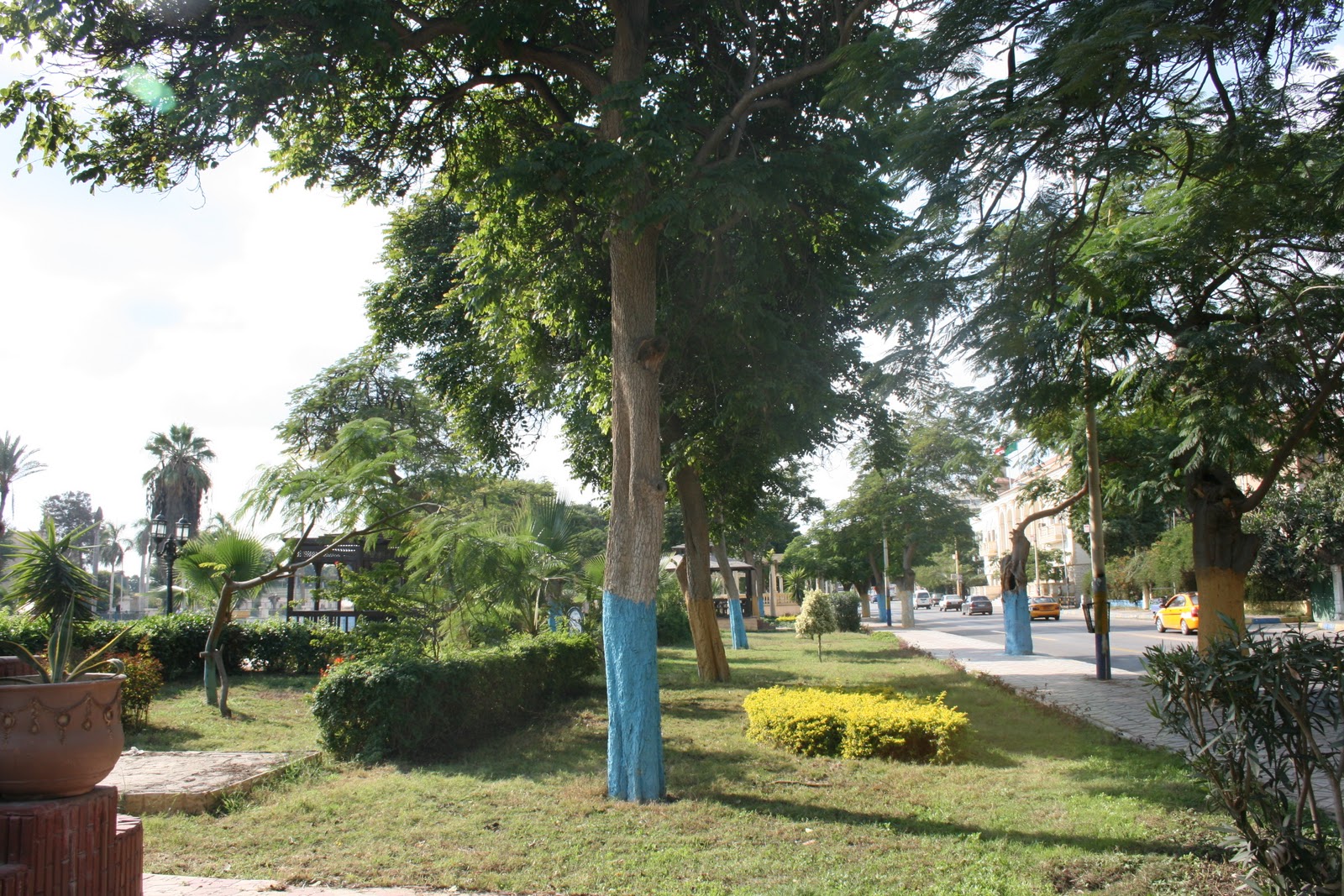
Ever city must have its own football team, but more importantly, its own football fan club. Ismailia has the yellow dragons. There are murals around the city honoring the team. Street curbs and trees* are painted the team's colors-- yellow and blue.


*tree trunks throughout Egypt are painted as a form of insecticide. In Cairo many tree trucks were painted red, black, and white after the Revolution.
I noticed this form of insecticide during my travels in India.

Ismailia, E-day


This photograph was taken in Midan El Mamar, the center of the demonstrations during the 25 January Revolution in Ismailia. There are still military tanks stationed in the Midan.

Ismailia is half way between Port Said (to the north, on the Medterrain Sea) and Suez (to the south) and is the base of Egypt's second army. Ismailia is the hometown of Hasan Al-Bana, founder of the Muslim Brotherhood. Compared to Cairo, Ismailia is a small city (10-20 million vs. less than 1 million).
Nicholas Kristof recently reported from the city.
http://www.nytimes.com/2011/12/11/opinion/sunday/kristof-Democracy-in-the-Muslim-Brotherhoods-Birthplace.html

I traveled to Ismailia yesterday to witness the second-round of Egyptian parliamentary elections taking place in the city. I was surprised by the general lack of election-fever in the city. From what I observed, there was no campaigning outside of polling stations-- which is illegal by Egyptian law, but nevertheless took place during the first round of elections in Cairo. Like Cairo, however, there were campaigns posters dotting all of the walls in the city too.
I was surprised by the reach of the April 6th movement's "White Circle, Black Circle" campaign in the city. I had only seen black circles in Cairo, not white circles. In contrast, both black and white circles were spray-painted in abundance around the city center. The circles were not necessarily painted on campaign posters.
http://www.thedailynewsegypt.com/egypt-elections-2011/muslim-brotherhood-stronghold-sees-possible-vote-split-dp1.html


Tuesday, December 13, 2011

Vote for nobody


Polls begin in 9 governates tomorrow. While Cairo had its elections 2 weeks ago, election-fever is still palpable here: Giza, located on the other side of the Nile (where the pyramids are) and just two metro stops from downtown Cairo, will have its elections tomorrow.

Located on Mohamed Mahmoud St., around the corner from Midan Tahrir, this is the first election related street art that I've seen in Egypt.

Voter turn-out was remarkably lower during the run-off elections last week than during the initial polls. I hope that the voter turn out is high tomorrow and Egyptians exercise their right to vote and duty to shape their country. A general sense of excitement surrounded the first polls and I hope that that excitement returns-- after all there are still three rounds of elections for the Shoura Council (the upper house of parliament) early next year, not to mention the presidential elections which SCAF recently promised will be held in June 2012 and a probable constitutional referendum.
http://english.ahram.org.eg/NewsContentPrint/4/0/28243/Opinion/0/Elections-and-their-discontents.aspx
The world cares, so I hope Egypt does too.


Monday, December 12, 2011

V for Vendetta

Over the past few weeks, I have noticed the emergence of "V" street-art in Cairo in reference to the film V for Vendetta.
The street-art focuses primarily around the letter V which has been transformed into the letter A by the Ultras Ahly, giving the film spoof a uniquely Cairo quality. There phrase "Remember, Remember the 19th of November," a spoof of the film's phrase "Remember, Remember the 5th of November," is also spray-painted on the streets. The mask itself has not been worn at any demonstrations (unlike at the Occupy Wall Street protests in New York where apparently such an act is illegal in the US http://online.wsj.com/article/SB10001424053111904194604576581171443151568.html).

I first watched the film V for Vendetta a few months ago here in Cairo. I had intended to watch it years ago-- I had the DVD in my possession last spring, but had to return it to Netflix before finishing it because my free-trial expired. In Egypt I watched a pirated copy that an Egyptian friend lent me, he had watched the film shortly after its release but still had it saved on his laptop. As the Arabic subtitles rolled across the screen, chants from Maglis Al Sha'ab sit-in were audible in the distance: Remember, Remember? How could you ever forget.


Located on the side of the 6th of October bridge in El Geziera, this stencil is by the street-artist Ganzeer. I took the photograph the first weekend in December, although it's been here since my arrival in early August. 


This photograph was taken in front of the Mugamma on Saturday 26 November during the recent Tahrir clashes. Since then the V has been spray-painted next to the words (and the letter M in november added). 


In the Sadat metro (under Midan Tahrir). This V is quite popular and can be found around the city. 

On Qasr Al-Aini St., near Midan Tahrir.
Is the black circle a reference to the April 6th movement's "White Circle, Black Circle" awareness campaign? Is V triumphing over El Feloul (the remnants of the old regime)?
There is no fist (a sign for the April 6th movement) to definitively indicate that it is in fact a part of the campaign. 


On Qasr Al-Aini St., near Midan Tahrir.
The Ultras Ahly (the football fan club of the major ) have spoofed on the V signature. Flipping the letter upside down, the letter A represents Ahly. The Ahly A is very popular (more popular than the V) and can be found around Cairo.


On Qasr Al-Aini St., near the Maglis Al-Sha'ab sit-in.


Here the same A is used in the infamous acronym ACAB. This A had not previously been used in this acronym. On the on Qasr Al Aini St., near Midan Tahrir.


Saturday, December 10, 2011

Eyes, edited

The expression goes that eyes are the window into the soul. Well, it appears that eyes are the window into the street.
The mural of the living martyrs on Mohamed Mahmoud St. has evolved and the eye patches are now being written on. Sadly some of the portraits have been defaced with crude jokes, but still others have the name of the living martyr or an expression of hope.


Translation: "God is great over all evil."

Tuesday, December 6, 2011

Transparent Faces


I took these photographs last weekend. While the Wall remains on Mohamed Mahmoud Street, passer-bys are now able to walk up to the wall (or close to it at least, young revolutionaries still stand guard in huddles). Previously there had been a no-go zone complete with barbed-wire and looted Cairo police traffic-barriers and enforced by young revolutionaries. This was the first time I had walked the length of Mohamed Mahmoud Street since the outbreak of the recent clashes. I am quite familiar with the street-- it is the location of the AUC bus-stop-- and was pleasantly surprised to see that most of the street art remained untouched; I wasn't sure if I would find the walls blackened from ash.
The mural depicts those living martyrs who lost their eyes during the recent clashes. All of the faces in the mural were transparent-- their skin was the wall itself. Are the living martyrs a reflection of the street or the realization of it?

One living martyr's face was partially composed of a campaign poster.
Today concluded the second day of the run-off polls in the first round of voting for the Maglis Al Sha'ab (there are three rounds of polls for the lower house of parliament, there will be an additional three round of polls for the upper house early next year). Run-off polls were only in those districts in which an individual candidate (whether in the professional or worker/ farmer category) didn't achieve more than 50% of the vote in the initial poll- thus there were only either two or four candidates on the ballot. There were no run-off polls for the party/alliance-lists.
Voter turn-out is visibly remarkably lower than in last week's election- there is not as much excitement as there was a week ago- it appears the novelty has already worn off for some. There were hardly any lines and also hardly any Muslim Brotherhood volunteers- although the latter perhaps because they had been so helpful before.
I had one friend who went to the poll and "voted," but in reality scratched his ballot. Unlike his Aunt, he didn't vote because of the alleged 500 pound (100 US dollar) fine- He voted to be a part of the process, yet scratched because he didn't like his options (The Muslim Brotherhood's Freedom & Justice Party or the Salafi Nour Party).
Whoever wins and whenever they actually take their seat (Parliament supposedly opens in March 2012), I sincerely hope they don't forget about these martyrs and their families. They are the veterans of a war fought too close to home.

Sunday, December 4, 2011

The Martyr


Translation (partly obstructed by the tree):
Martyr
Tarek Abdel Latif
32 years-old, engineer


In light of last Friday's demonstration to honor the martyrs of the recent clashes, this weekend I went in search of another mural in the Martyr Mural Series by the street artist Ganzeer.
This mural is located in El Gezira, near the 6th of October Bridge. It was painted on April 16th, 2011.

Tuesday, November 29, 2011

day 2


Translation: "Freedom is coming forever."
This photograph was taken on Saturday 26 November, around the corner from The Wall.

Will elections set Egyptians free?

Voting was extended from 1 day to 2 days by SCAF last Friday.


I have been surprised by the lack of election street art in Cairo. While most street art is in itself political, as far as I have seen, none of it directly references the elections. While I mentioned in a previous post that some candidates painted their names on buildings in the village I visited, I have not seen any such street art in Cairo. Candidates do plaster campaign posters on walls (and in most cases, identical posters directly next to each other) and hang up banners, but there are no interpretative murals depicting their faces or names. Each party and candidate had a symbol (to aid illiterate voters), but none of these symbols were painted on the streets. There is also no street art depicting the importance of voting-- not so much as the word VOTE. Voter education programs certainly exist in Cairo, but they didn't use street art to reach the masses. Furthermore, what does the lack of election street art imply about the street artists themselves?

The Muslim Brotherhood (and their political arm, the Freedom and Justice Party [FJP]) may not have used street art, but they certainly got their message across. At every polling station that I walked past (and as was the same with my friends) in the past 2 days the FJP had a large contingent of volunteers. The FJP had a booth with laptops at each polling station to assist voters with finding their legna (polling station) number (voters needed to record the number along with their name and ID number before voting) in addition t numerous volunteers passing out flyers despite a ban on campaigning 48 hours before elections. Is this freedom?


Sunday, November 27, 2011

The wall


Translation: "Freedom is coming forever" (hureya geya labd)
I took this photo on Saturday 26 November. The wall can be seen in the back of the photo; it is not currently possible to get closer to the wall.
Below is a zoomed-in version of the photo above. Besides the words "hureya geya labd," there is no other street art on the wall.


The army began constructing the wall on Thursday 24 November in order to stop on-going clashes between protesters (based out of Midan Tahrir) and the Central Security Forces (defending the Ministry of Interior) on Mohamed Mahmoud St., a side street leading into Midan Tahrir.
The army built a wall around the Israeli Embassy in Dokhi (in Giza, across the nile from downtown Cairo), after demonstrations following the killing of Egyptian soldiers by the Israeli army (who were chasing terrorists allegedly involved in the Eliat bombings) on Thursday 18 August 2011.
Unlike the wall on Mohamed Mahmoud St., the wall in front of the Israeli embassy was covered in street art.
The wall in front of the Israeli embassy was torn down on the night of the 9 September demonstrations. Many here compared its destruction to the fall of the Berlin Wall.
What will happen to the wall on Mohamed Mahmoud St.? Will it be torn down? Will it soon be covered in street art? Is the existence of one piece of street art indicative of the fact that the people in Midan Tahrir are united?


The KFC is partially visible on the left side of the photograph. The words "yuskut al musher" (down with the musher) were written on the metal door. These are the first words written on it. As I mentioned in a previous post, there used to be wooden boards, but they were replaced by the metal door roughly a month ago.

NOTE: The AUC bus-stop used to be located a few meters from the wall. The bus-stop has since been re-located.


Translation:" Street of the massacre of the Basher, Mohamed Mahmoud (formerly)"

Mohamed Mahmoud Street, located just off of Midan Tahrir, was the main site of clashes between security forces and protesters last week. The street has since (unofficially) been re-named "Martyr Street."
After the Revolution, the Mubarak metro stop was also renamed "The Martyrs."

The Grim Reeper mural, located down the wall from this mural, remains untouched.

Saturday, November 19, 2011

The Grim Reeper


Translation: "Revolution"

The hooded figure looks like the Grim Reeper or even a Dementor from Harry Potter.
The word revolution is painted in red, the color of blood. Is SCAF the Dementor and feeding off of the Revolution, the blood of those Egyptians who have died and the hearts of those who still remain in the Midan?

Why is the Dementor white and not black? Could it be a spoof off of the belief SCAF is the only viable option-- the only light at the end of the tunnel, so to speak-- in the chaos that has become Egypt?
I have heard many of my colleagues at AUC (not from the people in the Midan), that that Egypt has no option except for SCAF, that there is no alternative. (I have even heard not-so-hushed whispers that SCAF is a better alternative to the Islamists ruling Egypt.)


This mural was painted on Friday 19 November during the demonstrations. It was painted on Mohamed Mahmoud Street, just around the corner from The Wall and the street that the AUC Downtown campus gate is located.
The street is now the site of on-going fighting between demonstrators and the CSF (Central Security Forces)* that erupted after the CSF attempted to forcibly remove demonstrators who were occupying the Midan after Friday's demonstration.
The street (one of many running into Midan Tahrir) connects the Midan to the Ministry of Interior (MOI). As the battle for control of Midan Tahrir is under way, the CSF (along with the police? and military police?) is loosely using the MOI as their home base, retreating there/ in that direction if/when necessary.

*There are many different types of Egyptian government security and the distinction at times can be crucial. (For example, during the Revolution it was the army who stepped in to protect the people when the CSF were attacking them).
Central Security Forces (CSF)= Amn al-Markazi
Army= Gesh
Police= Shorta
Military Police= Shorta al-Askaree
And then there is the plain clothes police

UPDATE, Tuesday 22 November
Here's a great article from Al Jazeera outlining the differences between the "familiar mix of black-clad riot police and baton-wielding soldiers in fatigues."


Sunday, November 13, 2011

Egypt, mother ship


Painted in 22 July 2011, by the artist Shehab. The street art is on El Shiehk Rihan street, behind The Mugamma.
Translation: "Egypt, mother ship: You will dock on the land and you will not sink with us [the Egyptians]."
There is a second, unrelated, piece of street art written above, "Yes, to the honorable 25 January Revolution."

The first piece of street art references a famous Egyptian song "Egypt, mother ship" written by Ahmed Fouad Negm (his nickname is Al Fagomy) in 1967 after the "nkba" [catastrophe], i.e. Israeli victory of The Six-Day War in which Israel seized the Sinai Peninsula from Egypt. The song was originally sung by the late Sheikh Imam.

Egypt is once again in turbulent waters. Egypt will land once it has a parliament and a president and a constitution, I can see her in the distance now.


Ahmed Fouad Negm is a reknonwed Egyptian poet. He is the father of Nawara Negm-- a journalist who writes the popular blog Gabhet El Tahyees El Shaabeya (The Popular Front of Sarcasm).
Ahmed Fouad Negm and Sheikh Imam often collaborated. Both spent time in prison for their songs which criticized the Egyptian government.

Here is a link to the song, preformed in the famous Egyptian movie "Tareq Ila Eliat" (The path to Eliat) which commemorates the Egyptian victory over Israel in the 1973 war (October 6th [the first day of the 1973 war] is a national holiday in Egypt).
The video includes English subtitles

Here is a link to Sheikh Imam singing the entire song.


Saturday, November 12, 2011

Checkmate


An iconic piece of street art by the artist El Teneen, the piece was drawn during the Revolution and has remained relatively untouched since. All of the pawns are on one side of the chessboard, except for the king-- who is flipped over, & other ranking pieces.

Who is moving the pieces?

Thursday, November 3, 2011

Banksy?

While Banksy's work has not been directly spotted in Cairo, his presence is nevertheless felt. His film "Exit Through The Giftshop" will be screened later this week at the Townhouse Gallery.
http://english.ahram.org.eg/NewsContent/5/32/23258/Arts--Culture/Film/Graffiti-artist-Banksys-first-film-to-be-screened-.aspx
I have admired Banksy's work from afar for many years. He is a British graffiti-artist who is one of the pioneer's of street art. He has done many provocative works across the globe, yet never shows his face (even in his film). He has done several pieces on the Israeli/ Palestinian Separation Wall. (http://www.banksy.co.uk/)

During the 28 October demonstrations, I found a piece of street art (right) that reminded me of one of Banksy's pieces (left).


The two pieces certainly have there differences (for starters, the two men are facing in opposite directions), but I nevertheless find them remarkably similar.

While the man in Banksy's piece is throwing a bouquet of flowers, it is unclear what the man in the Cairo piece is throwing. Thoughts?


Wednesday, November 2, 2011

A Spaniard in Cairo


Translation: "We have dreams"

As I was looking for the RGB exhibit at the Townhouse Gallery last Sunday night, I entered the wrong gallery and came across this mural. The people pictured are not creating the mural, but in the process of preparing for the next night's fashion show featuring made-in Egypt clothing.

The Spanish artist Eva Mena, who is known by the name Den, painted the mural. She is in Cairo to participate in the Fourth Mediterranean Hip Hop Festival. She was suppose to collaborate with the Alexandrian graffiti artist Aya Tarek, but he had to cancel due to a scheduling conflict.

While this mural was painted inside the Townhouse gallery, the artist is nevertheless foreign. In the post-Revolution artistic spring, should the streets of Egypt be reserved for Egyptians?

Wednesday, October 5, 2011

al-Shaheed (Martyr)


This is one mural in a series titled The Martyr Murals. The series is the brainchild of artist Ganzeer (aka Mohamed Fahmy). In his words, "The goal [of the project] is to, on the one hand, honor the martyrs, and on the other hand provide passers-by with a reminder of Egypt's struggle for freedom, democracy, and equality."
Every mural in the series has the word "al Shaheed" (martyr), the person's name, age and occupation. This is Seif Allah Mustafa. He was 16 years old and he was a student.

There used to be a Martyr Mural near a favorite juice shop of mine in Midan Falaki, but unfortunately I was never able to see it because it was painted over in late April. (The mural itself was only painted in March so it was only up for about a month).


Ganzeer has his own blog
http://ganzeer.blogspot.com/2011/03/martyr-murals-project.html

Ganzeer also created a google map to map street art in Cairo. The map, of course, couldn't and doesn't include all of Cairo's street art . While I think the map is a great idea, there's so much street art in Cairo-- you can turn a corner and find something interesting-- that I'm not sure how effective the map is. Some of the tags do have pictures (although many don't) which is helpful if you are looking for a specific peace of art.
-I am going to tag all of my posts with the neighboorhood where the street art work from that post is.
-I will also provide a location (street/ landmark), in case any of you are in Cairo!
-I will also tag the name of the street artist (if known).
-If the street art is a stencil or part of a series, I will tag it as well.
-I will include the date of when the photos were taken, all photos that I post are my photographs.
http://ganzeer.com/cairostreetart/index.html


This mural is in downtown Cairo, on 26 July St. (a major street), in front of the Dar Al Qada' (the Supreme Court). This photo was taken on September 9th, 2011.