Showing posts with label Demonstration. Show all posts

Friday, December 2, 2011

Eyes

Can this be called street art? Or is it vandalism.


This is one of four lions on the Qasr Al-Aini bridge connecting El Gezira (an island in the middle of the nile) and downtown.

This is a statue of Shiek Omar Makaram in front of the Omar Makram mosque in Midan Tahrir.


Demonstrators marched this Friday to Midan Tahrir in order to honor the Marytrs of the recent clashes. Some wore patches over their eyes in solidarity with those who lost their eyes from rubber bullets in the recent clashes.

The loss of eyes was particularly noteworthy in the recent clashes. Ahmed Harara is a lauded figure: he lost one eye during the 25 January Revolution and his second eye during the recent clashes.
Below is a stencil of Ahmed Harara taken in front of the Maglis Al Sha'ab earlier this week.

In place of his right eye, 19 November
in place of his left eye, 25 January

Monday, November 28, 2011

Remember


This photograph was taken in front of the Mugamma on Saturday 26 November during the on-going occupation of Midan Tahrir.
Saturday November 19th is the day that the recent clashes in Midan Tahrir began after the Central Security Forces (CSF) used violence to evict peaceful protesters from the Midan.

Is this street art a reference to the film V for Vendetta (Remember, Remember the 5th of November)?


As the first round of parliamentary elections began today in Cairo (and 8 other governorates, including Alexandria and Luxor), the April 6th movement encouraged voters to wear black in remembrance of those who died in the recent clashes in Midan Tahrir.
Despite the long lines at many polling stations today, it only takes one stroll through Midan Tahrir to Remember the 19th of November.

Sunday, November 27, 2011

Is This Chaos?


Translation: "This is Chaos?"
I took this photo on Monday 21 November at The Mugamma.

The street art is a spoof of the famous 2007 Egyptian film "This is Chaos" from the Egyptian director Youssef Chahine. The film focuses on the story of a corrupt policeman (Hatim, played by the actor Khaled Salah) who falls in love with a young teacher (Nour, played by the actress Hala Sadky). He continues to pursue her despite the teacher become engaged to her school's principal's son, a high ranking government official. Hatim proceeds to rape Nour and hide the evidence. Nour and her fiancee pursue the case and eventually find incriminating evidence against Hatim. At the end of the film, Hatim commits suicide.
NOTE: The title of the film does not include a question mark.

Below is a link to the film's trailer (without English subtitles)


The street art is a picture of Hatim with a gun before he commits suicide. Does the question mark in the street art serve to ask the people if the suicide of the police (of the government) is what they want? While Mubarak was certainly a brutal ruler, he didn't flee to Saudi Arabia, but rather stayed in Egypt to stand in court in front of his people. Do the Egyptian people want revenge or do they want justice? Is there a difference?
The saying goes that the best revenge is living well. It is my hope that the first round of parliamentary elections beginning tomorrow will be Egypt's first step towards living well.

The wall


Translation: "Freedom is coming forever" (hureya geya labd)
I took this photo on Saturday 26 November. The wall can be seen in the back of the photo; it is not currently possible to get closer to the wall.
Below is a zoomed-in version of the photo above. Besides the words "hureya geya labd," there is no other street art on the wall.


The army began constructing the wall on Thursday 24 November in order to stop on-going clashes between protesters (based out of Midan Tahrir) and the Central Security Forces (defending the Ministry of Interior) on Mohamed Mahmoud St., a side street leading into Midan Tahrir.
The army built a wall around the Israeli Embassy in Dokhi (in Giza, across the nile from downtown Cairo), after demonstrations following the killing of Egyptian soldiers by the Israeli army (who were chasing terrorists allegedly involved in the Eliat bombings) on Thursday 18 August 2011.
Unlike the wall on Mohamed Mahmoud St., the wall in front of the Israeli embassy was covered in street art.
The wall in front of the Israeli embassy was torn down on the night of the 9 September demonstrations. Many here compared its destruction to the fall of the Berlin Wall.
What will happen to the wall on Mohamed Mahmoud St.? Will it be torn down? Will it soon be covered in street art? Is the existence of one piece of street art indicative of the fact that the people in Midan Tahrir are united?


The KFC is partially visible on the left side of the photograph. The words "yuskut al musher" (down with the musher) were written on the metal door. These are the first words written on it. As I mentioned in a previous post, there used to be wooden boards, but they were replaced by the metal door roughly a month ago.

NOTE: The AUC bus-stop used to be located a few meters from the wall. The bus-stop has since been re-located.


Translation:" Street of the massacre of the Basher, Mohamed Mahmoud (formerly)"

Mohamed Mahmoud Street, located just off of Midan Tahrir, was the main site of clashes between security forces and protesters last week. The street has since (unofficially) been re-named "Martyr Street."
After the Revolution, the Mubarak metro stop was also renamed "The Martyrs."

The Grim Reeper mural, located down the wall from this mural, remains untouched.

Saturday, November 26, 2011

El Menoufia


Translation:
Sadat was from Menoufia.
Mubarak is from Menoufia.
(Essam) Sharaf (former PM, resigned on Monday 21 November) is from Menoufia.
(Kamal) El Shazly (a prominent former member of the NDP who passed away before the 2010 parliamentary elections) is from Menoufia.
(Ahmed) Ezz (a famous businessman under Mubarak who is now in jail awaiting trial, owner of Ezz Steel) is from Menoufia.
(Kamal) El Ganzory (newly appointed PM, former PM from 1996-1999) is from Menoufia.
Menoufia is playing single*
and all of Egypt are standing next.

*in the street art, the Arabic word "single" is simply the English word transliterated. "Single" refers a person playing a game by himself.


Menofia is one of 27 governorates in Egypt. Many prominent members of Egyptian politics have come from Menofia.


This particular piece of street art is not actually painted on the wall, rather it is a sign that was leaned against a wall. If it's portable, it's owner can take it with him when he leaves and protect it from becoming erased. Furthermore because it's portable this street art has a unique owner who can do with it what he pleases. Is this street art? Or must the street own it in order for it to be called street art?


Know thy Enemy


Translation: "Know thy enemy: Hamdi Badeen"
This stencil has begun appearing in downtown Cairo in the last few days, some renditions of it include the words "WANTED." Was the creator of this stencil inspired by the WANTED El Shenawy street art? El Shenawy was, after all, captured.
Hamdi Badeen is the chief of the military police (el shorta el askarya). The military police is in charge of policing the military. After the Revolution and the establishment of SCAF (a military junta as opposed to a civilian transitional council), their jurisdiction expanded to include civilians. The military police now have the power to arrest both police and civilians, hence civilians are now being tried in military courts.

Hamdi Badeen recently said that the army hasn't entered Midan Tahrir since they withdrew in September (the day before the massive 9 September demonstration; since the beginning of Ramadan they had controlled the Midan and allowed no protests). Widely circulated photographs and videos, however, prove otherwise.

Many activists called for Hamdi Badeen's trial after the Maspero clashes.

Killed in Action


An activist was killed early this morning on Qasr Al-Aini Street, near the Maglis Al Sha'ab- he was run over by a police van & died of internal injuries. Activists began an open ended sit-in in front of the Maglis Al Sha'ab (located close to Midan Tahrir) the night before in order to prevent the newly appointed Prime Minister Kamel Ganzouri from entering office.
When I arrived at the scene at approximately 3pm, the area where the activist was killed was cornered off and other activists were explaining what happened to those cars which slowed down to look.

Can something be art if it's real?


Translation: "Blood of the martyr of military rule"
These words-- written in chalk-- were next to the scene.

Friday, November 25, 2011

Glory for the Rioters


Translation: "The glory for the rioters" (El Maged Ll Moshagbeen)
This graffiti was created today on the wall of the Mugamma.

This street art is a spoof of the famous Egyptian play (and subsequent film) "The School of the Rioters" (Madrasah Al-Moshagbeen). The play debuted after the 1973 war with a venerable cast- including Adel Imam, Ahmed Zeky, Saed Saleh, Hasan Mostfa and Soher El Bably.
In the play, the principle can't control his students despite his many attempts at disciplining them. The students tirelessly play jokes on their teachers, until the principal hires a new teacher who eventually reforms them by first becoming their friend and earning their trust and respect.

While street art is giving praise to the rioters, does the reference to the play allow that these rioters can eventually be tamed? If so, who is the teacher that will tame them?
Massive demonstrations took place today in Midan Tahrir and in several other cities across Egypt, calling for an end to military and a shift transition to civilian rule lead by a National Salvation Council. Rejecting SCAF's appointment of Kamel El-Ganzouri as the new Prime Minister, representatives of youth & revolutionary movements appointed Mohamed El-Baradei, Nobel Peace Prize winner and former head of the IAEA, as the head of the National Salvation Council. Will Baradei be able to tame the rioters?


Here is a clip of the play (without English subtitles), featuring the actor Adel Imam.

the Shahada


Translation: "There is no God but Allah and Muhammad is his messenger" (la ilaha illallah Muhammad rasulu illah).
This stencil of the Shahada is now very common in Midan Tahrir.
After someone dies, a Muslim says "We are for Allah and we are returning to him" (inna lillahi wa inna ilayhi raji'oon). When in a state of disbelief or shock, a Muslim may instinctively say the Shahada- "There is no God but Allah and Muhammad is his messenger" (la ilaha illallah Muhammad rasulu illah). The Shahada is the Muslim testimony of belief.


Throughout the past week, I have heard shouts of "Allahu Akbar" in Midan Tahrir. I have seen men stop chanting against military rule in order to pray. I have watched as ambulances drive the injured from the site of the clashes to the large field hospital in Omar Makram Mosque on the other side of the Midan while men and women hold hands to make sure there is a clear path. I pushed my way through a crowd with the help of a woman wearing the niqab. And I have heard people muttering "la ilaha illallah Muhammad rasulu illah" when they see a bloody picture from Al Jazeera on their smart phone or learn than yet another person has died in the clashes.
Yes Islam is present in the Midan, but Islam is present in Egypt. This is not an Islamic Revolution, this is an Egyptian Revolution.


Thursday, November 24, 2011

No to military rule

This is a very popular form of the stylized "لا" ("No" in Arabic), seen in many different shapes & sizes as parts of different street art throughout Cairo. This "لا" was used in the campaign against military trials.
I saw this particular incarnation of "لا" today on a wall of the Mugamma in Midan Tahrir. While I'm not sure who the artist is, I know it was painted today because I didn't see it yesterday as I passed by the Mugamma.


Translation: "No to Military Rule"


This English translation was next to the Arabic street art.

WANTED

UPDATE 30 November 2011:
El Shenawy turned himself into the Ministry of Interior.

UPDATE, 27 November 2011:
El Shenawy was not captured, but he will be summoned for questioning within the next 72 hours.
http://english.ahram.org.eg/NewsContent/1/64/28051/Egypt/Politics-/Security-source-denies-notorious-CSF-officer-at-la.aspx


Translation:
WANTED
Search with the People

Two-Star Officer*: Mahmoud Sobhy El Shenawy
Officer in the Central Security Forces, accused of targeting eyes
Tens from the revolutionaries, the heroes in Tahrir.


Here is video of El Shenawy shooting protesters. This video was widely circulated on the internet.
Leaflets were distributed around Midan Tahrir with a still-photo from the above video, stating that there's a 5,000 Egyptian pound reward for anyone who finds El Shenawy.


*When an officer graduates from a 4 year college he automatically enters the CSF with 1 star. El Shenawy graduated college in 2009


Above are photos of the stencils used to produce the street art. The atmosphere in Midan Tahrir was very festive on Thursday--there were few ambulances and an abundance of families.
The violence near Midan Tahrir earlier in the week made it difficult for street artists to work. While the words down with SCAF were certainly abundant around Midan Tahrir, a certain degree of stability is necessary in order to create more detailed street art-- if you're worried about running from tear gas canisters, it's kind of hard to concentrate on making sure a stencil is straight.

Tuesday, November 22, 2011

S OU IL


Translation (of the spray-painted words): "Down with with military rule" (yuskut hokm el3askr)
The following is a photograph of the gate of the Maglis Al Shoura (Shoura Council) (the upper house in the Egyptian parliament).
The spray-paint is black and not very visible during the day, however, it is reflective at night.

The English letters were removed after the massive 9 September demonstration. The words were spray-painted two nights ago.

While English is an international language, why are the English letters as big (if not bigger) than the Arabic words? Were the English letters specifically targeted or were they taken down simply because they are easier to reach than the Arabic letters?
Furthermore, why did it take so long for someone to spray-paint the gate? While the words "yaskot 7okm el3askr" (down with military rule) were spray-painted as early as the 28 October demonstration (my personal photographs do not show any such street art before that demonstration, although I was not actively documenting street art before the end of September), the gate was only spray-painted after the deadly clashes in Midan Tahrir began. Does the very existence of this street art signal a turning point?

Monday, November 21, 2011

Where is the Love?


Translation: "Mubarak--> with love <-- Tantawi"

Standing in Midan Tahrir today, I heard the same chants that I heard on Al Jazeera 10 months ago- the only difference is that the name has changed. From Mubarak to Tantawi, one most wonder, where is the love for the Egyptian people?

The Mugamma

As the demonstrations against SCAF went into the third day on Monday 21 November, a sense of calm prevailed in Midan Tahrir. I walked around the Mugamma (a part of the Midan that I don't usually pass) and found the following street art. Since it has been many weeks since I've walked passed the Mugamma, I can't verify when this street art was created. Because of the words, I am fairly confident that most of this street art was created recently. As you can see, there is white paint under the street art meaning that there is street art underneath that was painted over.

The Mugamma is a symbol of Egyptian bureaucracy. Most foreigners dread it because the building is where they must go to get their visas renewed (and their requests sometimes get denied or more often shortened by several months). The Mugamma itself is a large building that is located on Midan Tahrir in between the AUC downtown campus and the Omar Makram Mosque. There is a large green space in front of the Mugamma and many tents have been set up there. While there are clashes taking place on the side streets near Midan Tahrir, many people have set up camp in the green spaces in Midan Tahrir and have been sleeping here.


Translation: "My weapon is my thoughts."


Translation: "The next Revolution."


Translation: "We wont forget those who died."


Translation: "All of this is just the first wave."

Translation: "The interior (ministry) with the thugs" (El dakhlya bltageya)
The Central Security Forces (CSF) who are battling with the protesters are under control of the Ministry of Interior.


Translation: "Be Careful of the SCAF, it is a dead poison."

The above street art references the famous 1955 Egyptian movie, Life or Death.
In a scene in the film the police announce on the radio, "From the govenor of Cairo to Ahmed Ibrahim [a character in the film]: Do not drink the medicine that you sent your daughter to retrieve. There is a dead poison in the medicine. When you hear this announcement call the police station. And to anyone who knows Ahmed Ibrahim, notify him or call the police station."
Below is a Youtube clip (without subtitles) of the scene.


Not all of the street art is writing, there are many images as well.

Translation: "We came back again"
The man has the word "police" written on him.

Translation: "The dogs howl... and the revolution marches on."


Sunday, November 20, 2011

The Revolution will NOT be Televised.

The state-run TV is notorious in Egypt. For many Al Jazerra is the station of choice, for reliable news in Egypt and the world in general.
While the state-run TV did reform after the Revolution, by most accounts, it's coverage during Maspero violence (in front of the state TV building, Maspero) only served to incite more violence.

Recently I have seen street art around Midan Tahrir focused on TVs.


Translation: "Descend to the street" (The word "descend" is a common word in Egypt-- you "descend" from the metro train to the platform).
I photographed this stencil during the demonstration on Friday 18 November near AUC Tahrir campus.

Who is telling whom to "Descend to the street?"
During the 9 October Maspero violence, State TV told Egyptians to "Descend to the street" to defend the military against the Christians. Is the street-artist mocking that incident?

From what I have seen on other blogs, this stencil-- created by Adham Bakry-- is not new and has appeared before. I, however, have not seen the stencil since my arrival in August. It made a strong comeback in the downtown area during Friday 18 November demonstrations.


This stencil first appeared on Sunday 20 November. While the stencil appears in a few places throughout Midan Tahrir, it is mostly limited to near the AUC Tahrir campus building. I photographed this specific stencil on The Wall.


As I look at this street art of TVs, I am reminded of the late African-American poet Gil Scott Heron's poem "The Revolution will not be Televised."

The refrain of the poem is "The Revolution will not be Televised." The Egyptian Revolution, however, was televised on State-run TV, Al Jazzera, BBC, any network you name it. And in contrast to his words ("There will be no highlights on the eleven o'clock news"), the Egyptian Revolution was on the eleven o'clock news around the world.

Scott Heron said "Green Acres, The Beverly Hillbillies, and Hooterville Junction will no longer be so damned relevant." Egyptian pop culture is, however, still relevant. Not all, but some of the graffiti in Cairo makes reference to an Egyptian film or the Egyptian version of "Green Acres."

So was Scott Heron wrong? He concludes his poem, "The Revolution will be no re-run brothers, the Revolution will be live." In these words, Scott Heron spoke an absolute truth.
There is no re-run, this is it. I may hear what seems like a re-run of sirens from my window, but for each victim in that ambulance the siren is all but real. No matter what information the state TV is spewing from the television in front of me, the sirens are still real; the chants are still loud. The Revolution will not be televised.

Saturday, November 19, 2011

The Grim Reeper


Translation: "Revolution"

The hooded figure looks like the Grim Reeper or even a Dementor from Harry Potter.
The word revolution is painted in red, the color of blood. Is SCAF the Dementor and feeding off of the Revolution, the blood of those Egyptians who have died and the hearts of those who still remain in the Midan?

Why is the Dementor white and not black? Could it be a spoof off of the belief SCAF is the only viable option-- the only light at the end of the tunnel, so to speak-- in the chaos that has become Egypt?
I have heard many of my colleagues at AUC (not from the people in the Midan), that that Egypt has no option except for SCAF, that there is no alternative. (I have even heard not-so-hushed whispers that SCAF is a better alternative to the Islamists ruling Egypt.)


This mural was painted on Friday 19 November during the demonstrations. It was painted on Mohamed Mahmoud Street, just around the corner from The Wall and the street that the AUC Downtown campus gate is located.
The street is now the site of on-going fighting between demonstrators and the CSF (Central Security Forces)* that erupted after the CSF attempted to forcibly remove demonstrators who were occupying the Midan after Friday's demonstration.
The street (one of many running into Midan Tahrir) connects the Midan to the Ministry of Interior (MOI). As the battle for control of Midan Tahrir is under way, the CSF (along with the police? and military police?) is loosely using the MOI as their home base, retreating there/ in that direction if/when necessary.

*There are many different types of Egyptian government security and the distinction at times can be crucial. (For example, during the Revolution it was the army who stepped in to protect the people when the CSF were attacking them).
Central Security Forces (CSF)= Amn al-Markazi
Army= Gesh
Police= Shorta
Military Police= Shorta al-Askaree
And then there is the plain clothes police

UPDATE, Tuesday 22 November
Here's a great article from Al Jazeera outlining the differences between the "familiar mix of black-clad riot police and baton-wielding soldiers in fatigues."


Democracy


This photo was taken earlier this evening at approximately 7pm as I was passing through Midan Tahrir en route to visit a friend in another neighborhood in Cairo. I saw the word "Democracy" spray-painted on The Wall and quickly snapped a photo on my iphone. People were scalling The Wall and sitting on top of the AUC buildings in order to watch the fighting on Mohamed Mahmoud Street. Clashes broke out in and around Midan Tahrir on Saturday after a peaceful sit-in was violently dispersed earlier in the day.

While much of the graffiti in Cairo is in Arabic, it isn't uncommon to see graffiti in English. I have always been befuddled by this. The language of Egypt is Arabic afterall and not everyone can read English, let alone speak it. Furthermore, not everyone is literate! The cleverness of so much of the graffiti is that anyone can understand it-- you don't need to know how to read to understand a picture of Mubarak with a bullet in his head.

The word "Democracy," however, is particularly interesting word.
In Arabic the word democracy is democratiya, very similar to the English word. Both words derive from the Greek word, "Demos" meaning people and "Kratos" meaning rule. While it might seem as though the Arabic word was merely translitered from the English word, let's remember that the works of Aristotle and Plato were translated into Arabic as early as the 8th century AD.
I am nevertheless reminded of a passage from my favorite book, The Posionwood Bible, by Barbra Kingsolver,
"When a government comes crashing down, it crushes those who were living under its roof. People like Mama Mwanza never knew the house was there at all. Independence is a complex word in a foreign tongue. To resist occupation, whether you’re a nation or merely a woman, you must understand the language of your enemy. Conquest and liberation and democracy and divorce are words that mean squat, basically, when you have hungry children and clothes to get out on the line and it looks like rain."
The people in Midan Tahrir know what Democracy means in English, but I'm not sure they yet know the meaning in their native tongue. Democracy is certainly a complex word in a foreign tongue. But is this really the language of the enemy? I don't think SCAF knows the meaning of the word either.

Mulling over these thoughts, I descended into the depths of the Sadat metro station under Midan Tahrir and caught a particularly potent whiff of tear gas. As it stung my eyes, my body's natural reaction was to flush out the chemicals-- and so it was, in that moment, that I shed my first tear for Egypt. For a country with so much promise, for which too many innocent lives have already been lost. Inshallah, Egypt, you will know the meaning of democratiya.

One Demand

UPDATE, 26 November 2011:
The cartoons were again on The Wall, with some new additions.


Friday 18 November was dubbed "Friday of One Demand," the one demand being the rejection of the super-constitutional principles issued earlier this week by SCAF. More than any other demonstration in Midan Tahrir since my arrival, this Friday was dominated by Islamists. (As a result, some jokingly called the day "Khandahar Friday" because the massive turnout of Islamists.)
The term "Islamist" is vague and often misleading. In that vain, the term "liberal" is misleading as well. Islamist is a broad term that often refers to those who advocate a state based strongly on religion and includes the Muslim Brotherhood (and their political party Freedom and Justice) and the Salafists. Specifically, the term salafist is associated with the Nour Party--the stereotype is that Salafists where the galabiya (long dress for man) and have a beard. The term Salafist, however, literally means a sunni muslim.
It is possible, however, to be both terms at once: you can wear a veil and liberal.
Here is a great map of the Egyptian political parties, cross-referencing the Western left-right spectrum with a religious-secular spectrum. The Egyptian political spectrum doesn't fit into either traditional model.


The Wall was covered in small cartoons painted on white cardboard and taped to the wall. Below is a sample of the cartoons.
Translation: "They will not kill the revolution"
"Revolution" is written on the budding plant; a military boot is attempting to squish it, but the plant pushes through.

Translation:"The Amn Al-Markezi (Central Security Forces) and AlShorta AlAskary (Military police) are one hand."
This cartoon is a spoof of of "The people and the army are one hand,"a popular slogan during the Revolution.


Translation: "The Council [SCAF] strongly supports freedom of opinion."
Field Marshall Tantawi [head of SCAF] is saying these words on State-TV, white shutting-up the satellite news channel Al Jazeera.


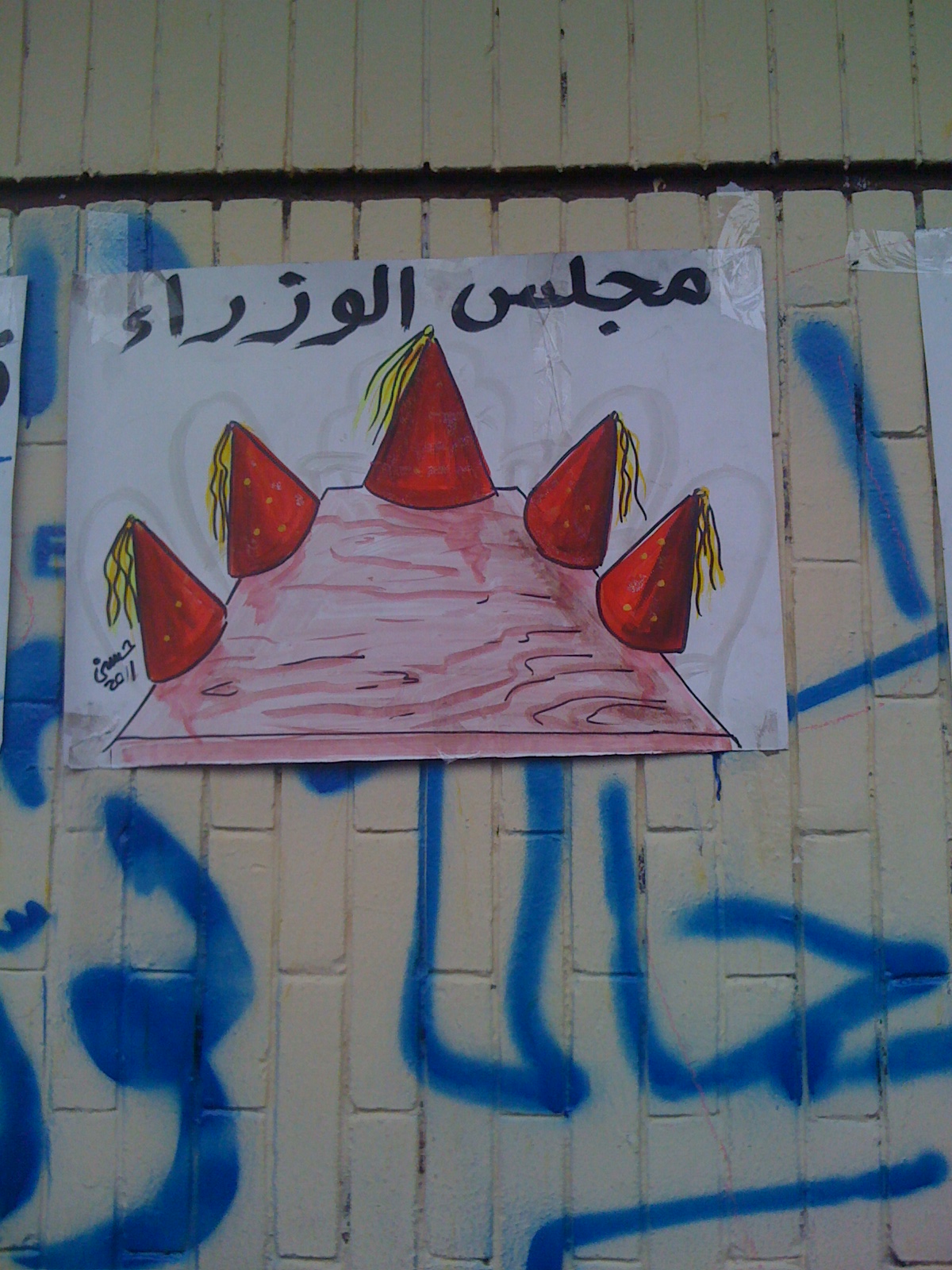
Translation:"The Council of the ministers"
In arabic "tartor" has two meanings 1) a hat worn for a birthday party and (very ammeya [Egyptian colloquial] 2) whipped (someone else has complete control over him).
This cartoon suggests that the ministers are completely controlled by the Council [SCAF.]

Translation: "Communique (#9876543)- the Council [SCAF] is sure that it will not stay in power,
dated 2030."
Many disliked the supra-constitutional principles because they enshrined the role of the military in politics; this cartoon is a spoof off of that fear. SCAF has thus far issued 87 communiques, communique#1 was issued on 10 February 2011 (the day before Mubark stepped down). All communiques are available (in Arabic) on SCAF's Facebook page.

Here is an article reviewing some communiques and how the promises that SCAF made in them have been broken.


The cartoons were taken down before nightfall and the following street art took its place.

Translation: "Down with military rule."
The ventilation window on The Wall has been converted into a prison cell, with a raised fist reaching out.

The following pieces of street are around the corner from The Wall.


Translation: "No mediator"
Several portraits are featured, including those of Field Marshall Tantawi and Alaa Abdel Fattah.


Translation: "Mass-murderer of maspero"
Field Marshall Tantawi is the man depicted as the devil.

Friday, November 4, 2011

UA07


"UAo7" is EVERYWHERE in Cairo. Initially I thought that street art said "Arab Unity 1956" - in reference to the Arab nationalism of Nasser.

In fact, "UA07" refers to "Ultras Ahly 2007."
Ahly is one of the main football (soccer) clubs in Egypt, the other is Zamalek. The term "Ultras" (not itself an Arabic word) means fan club- Zamalek's fan club is called Ultras White Knight (Zamalek's jerseys are white). 2007 refers to the year in which the Ultras Ahly were established.

The Ultras have become a potent force in Egypt- since the Revolution their relationship with the government has been shaky. They are large groups of young men who can easily mobilize. During the 9 September demonstrations the Ultras Ahly and Ultras White Knights came together in a rare show of unity to protest the alleged killing of members of the Ultras Ahly after a previous match. 9 September demonstrations later turned violent when the Israeli embassy was attacked and burned.

I attended the first Ahly football match after 9 September demonstrations. Before the match began, the Ultras Ahly displayed pictures of their members who were arrested at the 9 September demonstrations with pieces of black, white & red paper. While the football stadium has reserved seating for the Ultras Ahlys, I was nevertheless awestruck by the level of coordination needed for such a display.

Here is a youtube clip of the event. At around 15 seconds into the clip, you can see the faces of the Ultras Ahlys.


Thursday, November 3, 2011

Banksy?

While Banksy's work has not been directly spotted in Cairo, his presence is nevertheless felt. His film "Exit Through The Giftshop" will be screened later this week at the Townhouse Gallery.
http://english.ahram.org.eg/NewsContent/5/32/23258/Arts--Culture/Film/Graffiti-artist-Banksys-first-film-to-be-screened-.aspx
I have admired Banksy's work from afar for many years. He is a British graffiti-artist who is one of the pioneer's of street art. He has done many provocative works across the globe, yet never shows his face (even in his film). He has done several pieces on the Israeli/ Palestinian Separation Wall. (http://www.banksy.co.uk/)

During the 28 October demonstrations, I found a piece of street art (right) that reminded me of one of Banksy's pieces (left).


The two pieces certainly have there differences (for starters, the two men are facing in opposite directions), but I nevertheless find them remarkably similar.

While the man in Banksy's piece is throwing a bouquet of flowers, it is unclear what the man in the Cairo piece is throwing. Thoughts?