Saturday, November 12, 2011

Checkmate


An iconic piece of street art by the artist El Teneen, the piece was drawn during the Revolution and has remained relatively untouched since. All of the pawns are on one side of the chessboard, except for the king-- who is flipped over, & other ranking pieces.

Who is moving the pieces?

Thursday, November 10, 2011

El Feloul

UPDATE, Friday 18 November 2011:
A great article listing new political parties dominated or established by former NDP members.
UPDATE, Tuesday 15 November 2011:
Former NDP members are officially allowed to run in elections.


Translation: "No to the remnants [of the old regime, i.e. former NDP members]" (La llfeloul)
This photo was taken near the Ezbet El Nakhl metro station (approximately 35 minute metro ride from downtown).


The April 6th movement began a campaign-- "White Circle, Black Circle"-- identifying former NDP members or remnants (feloul) of the old regime. The movement paints a black circle over the campaign posters of former NDP members. "White Circle" represents that a candidate must have a "clean" past. The NDP was officially dissolved by court order on 16 April 2011, but some former members have joined other political parties (a former NDP official-- Hossam Badrawi-- even started his own party) and others are running as independent candidates.
It is worth noting that the former NDP headquarters located on the Nile, off of Midan Tahrir, were ransacked and burned during the Revolution. The building has yet to be restored or re-occupied.

The April 6th movement also created a website "Emsek Feloul" (Catch the Feloul) to identify former members of the NDP running in the upcoming parliamentary elections. Candidates are identified by geographic region.

The April 6th movement is not a political party, but rather a political movement. April 6th played a large role in the 25 January Revolution; it was founded in 2008 to organize labor protests.

Translation: "April 6th"
The fist is a part of the April 6th movement's logo.
I took this picture near the Helmeyet El-Zaitoun metro station (approximately 25 minute metro ride from downtown).

The Street Child


This piece of street art is located on the wall of an AUC building in downtown. The street art- an image of a street child is actually a white sticky-poster with black sharpie marker drawn over it.

While I can't be sure, I am fairly confident that this piece is by the street artist Dokhan. The work looks very similar to that which Dokhan created for the exhibit This is Not Graffiti at the Townhouse Gallery earlier this fall. I have re-posted the picture below.

Why do some street artists leave signatures (whether their name or a image [for example, a Sad Panda face] that identifies them) and others do not? Even in Dokhan doesn't leave a proper signature, is his artistic style a signature in and of itself? Is it ever possible to be truly anonymous?


Tuesday, November 8, 2011

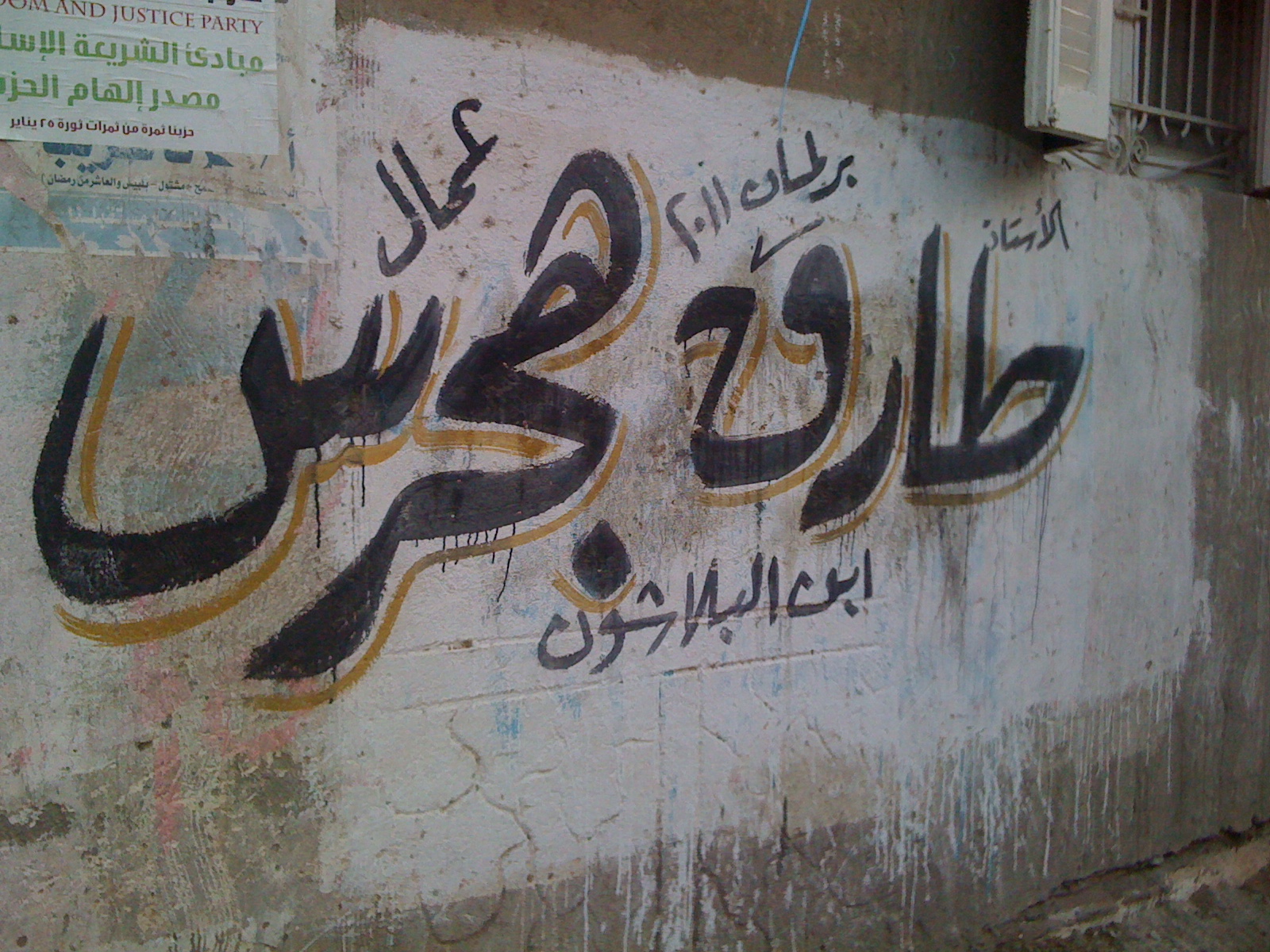
The Village- politics as usual


Translation: "Tarek Hagres, son of Blashon [the name of the Village- in the city of El Sharaky and in the state of Mashtool], parliament 2011, worker"

While there wasn't any graffiti in the village that I stayed in, some candidates for the upcoming parliamentary elections painted their names on the sides of buildings. Only the Freedom & Justice Party (the recently formed political party of the Muslim Brotherhood) had proper campaign posters. The Nour Party (the party of the Salafists, i.e. another Islamic party) also had a presence in the village, but the Freedom & Justice Party clearly dominated the village in terms of posters by at least 75:1.

Before I came to Cairo I read that the Freedom & Justice Party were the most organized party, but I didn't understand to what extent until I arrived. It's not just that the Freedom & Justice Party is the most organized party, it's the fact that none of the other political parties are organized. Apart from the Al Wasat Party (The Centrist Party)-- which broke form the Muslim Brotherhood in 1996, but didn't receive official recognition by the Political Party Committee until after the Revolution-- and the secular Free Egyptian Party-- founded by the Mobinil chairman Naguib Sawaris (himself a Christian) after the Revolution, most of the 50 odd political parties do very little advertising and even less to recruit new members.
The Freedom & Justice party, in contrast, has easily identifiable, standardized posters in every corner of Cairo. Al Wasat also has standardized posters, but not as many as the Freedom & Justice Party and the Free Egyptian Party has large bill boards on Ring Road (Cairo's version of a highway).
The Freedom & Justice Party does have an advantage because of its association with the Muslim Brotherhood which fielded independent candidates in previous elections and is itself a large Islamic organization which provides schooling and medical care to the underprivileged in Egypt, but the other parties seriously lack behind The Freedom & Justice Party.

The upcoming parliamentary elections (for the lower house, Maglis Al-Shaab) will be in 3 rounds to allow for jurisdictional supervision at each polling station. The elections will take place on 28 November, 14 December and 3 January with a run-off scheduled for a week after each election.
There will be two ballots-- 1 ballot for the individual list and 1 ballot for the party list.
On the individual list, a voter must vote for two candidates, one of whom must be a worker/ farmer.
The order of the party list is locked-in before the election and depends on the national vote-- if a party receives 10% of the vote, the first 10% of the names on their list will become MPs. There are currently 55 political parties registered and 350 party-lists. A party list can be either a single party or a coalition of parties.
Every other name on the Party list must alternate between a (fa'at-- i.e. a candidate, an educated person [lawyer, engineer, doctor] who attended college immediately after high school before beginning his career) and a worker (3mal-- one who works in a factory, even if he is educated now he must have begun his career as a worker before attending college)/ farmer (flah-- one who works on a farm [there is a restriction on the number of lands he can own]). The 50% quota for farmers existed under Mubarak, but was not strictly enforced. The quota for women in the parliament which Mubarak enacted is no longer in place, but women must be on the party list (they could, however, be at the bottom virtually guaranteeing that they will not become MPs).
The winners from the individual list will comprise 1/3 of the the Maglis Al-Shaab, while winners from the party list will compose 2/3 of the Maglis Al-Shaab. The Maglis Al-Shaab is composed of 508 representatives, 10 of whom are appointed by the President.
Here is a helpful diagram.

I learned the above information in my Egyptian Law course. IFES (the International Foundation for Election Systems) is a good source of information.


Translation: Freedom and Justice Party- "The principles of Islamic Law are the sources of inspiration for the party."


Translation: Muslim Brotherhood- "Islam is the Solution"

The Hand-print


Eid Al Adha [Festival of Sacrifice] is a Muslim holiday commemorating the willingness of Ibrahim to sacrifice his son Isma'il for God. Due to God's intervention Ibrahim slaughtered a sheep instead and to this day every year Muslim households slaughter a sheep. The sheep is slaughtered in a halal way- he is given food & water before being killed. The butcher says "In the name of God; God is the Greatest" (Bismillah; Allahu Akbar) and makes sure the animal doesn't see the knife.

In the Egyptian reef (countryside), it is common to smear the blood of the slaughtered sheep on the door of your home. Above is the picture of a hand-print on the door of a home I visited during Eid.

From a cultural perspective, the slaughter and the hand-print are not practices with which I am familiar. As a vegetarian, I do not support the cruel killing of animals, but in my opinion the slaughter was humane. Some of the street art in Cairo serves as a commemoration for martyrs, is the hand-print not another form of commemoration for the dead?


Saturday, November 5, 2011

All cops are


A.C.A.B. is an acronym meaning All Cops Are Bastards. This acronym is EVERYWHERE on the streets of Cairo.

The acronym by no means is unique to Egypt. In fact, a quick look at Wikipedia reveals than an alternative meaning is Always Carry A Bible.


The Man


Translation: "He who has a muddy* vs. Man" (Abo wesh[face] 3aker[muddy] vs. dakar)
Both of these words are VERY ammeya (Egyptian colloquial)
*my Egyptian friend had trouble translating this word for me, roughly a bad person who makes those around him not happy.
Field Marshall Tantawi (head of SCAF) is on the left and the detained blogger Alaa Abdel Fattah is on the right.


There is a black circle painted around Fattah- did the artist or a passer-by paint it? Either way, it appears Fattah is the winner.


Sad Panda's face is found in the bottom right corner of the photograph and I am thus assuming he is the artist.