Showing posts with label The Wall. Show all posts

Friday, November 25, 2011

the Shahada


Translation: "There is no God but Allah and Muhammad is his messenger" (la ilaha illallah Muhammad rasulu illah).
This stencil of the Shahada is now very common in Midan Tahrir.
After someone dies, a Muslim says "We are for Allah and we are returning to him" (inna lillahi wa inna ilayhi raji'oon). When in a state of disbelief or shock, a Muslim may instinctively say the Shahada- "There is no God but Allah and Muhammad is his messenger" (la ilaha illallah Muhammad rasulu illah). The Shahada is the Muslim testimony of belief.


Throughout the past week, I have heard shouts of "Allahu Akbar" in Midan Tahrir. I have seen men stop chanting against military rule in order to pray. I have watched as ambulances drive the injured from the site of the clashes to the large field hospital in Omar Makram Mosque on the other side of the Midan while men and women hold hands to make sure there is a clear path. I pushed my way through a crowd with the help of a woman wearing the niqab. And I have heard people muttering "la ilaha illallah Muhammad rasulu illah" when they see a bloody picture from Al Jazeera on their smart phone or learn than yet another person has died in the clashes.
Yes Islam is present in the Midan, but Islam is present in Egypt. This is not an Islamic Revolution, this is an Egyptian Revolution.


Saturday, November 19, 2011

Democracy


This photo was taken earlier this evening at approximately 7pm as I was passing through Midan Tahrir en route to visit a friend in another neighborhood in Cairo. I saw the word "Democracy" spray-painted on The Wall and quickly snapped a photo on my iphone. People were scalling The Wall and sitting on top of the AUC buildings in order to watch the fighting on Mohamed Mahmoud Street. Clashes broke out in and around Midan Tahrir on Saturday after a peaceful sit-in was violently dispersed earlier in the day.

While much of the graffiti in Cairo is in Arabic, it isn't uncommon to see graffiti in English. I have always been befuddled by this. The language of Egypt is Arabic afterall and not everyone can read English, let alone speak it. Furthermore, not everyone is literate! The cleverness of so much of the graffiti is that anyone can understand it-- you don't need to know how to read to understand a picture of Mubarak with a bullet in his head.

The word "Democracy," however, is particularly interesting word.
In Arabic the word democracy is democratiya, very similar to the English word. Both words derive from the Greek word, "Demos" meaning people and "Kratos" meaning rule. While it might seem as though the Arabic word was merely translitered from the English word, let's remember that the works of Aristotle and Plato were translated into Arabic as early as the 8th century AD.
I am nevertheless reminded of a passage from my favorite book, The Posionwood Bible, by Barbra Kingsolver,
"When a government comes crashing down, it crushes those who were living under its roof. People like Mama Mwanza never knew the house was there at all. Independence is a complex word in a foreign tongue. To resist occupation, whether you’re a nation or merely a woman, you must understand the language of your enemy. Conquest and liberation and democracy and divorce are words that mean squat, basically, when you have hungry children and clothes to get out on the line and it looks like rain."
The people in Midan Tahrir know what Democracy means in English, but I'm not sure they yet know the meaning in their native tongue. Democracy is certainly a complex word in a foreign tongue. But is this really the language of the enemy? I don't think SCAF knows the meaning of the word either.

Mulling over these thoughts, I descended into the depths of the Sadat metro station under Midan Tahrir and caught a particularly potent whiff of tear gas. As it stung my eyes, my body's natural reaction was to flush out the chemicals-- and so it was, in that moment, that I shed my first tear for Egypt. For a country with so much promise, for which too many innocent lives have already been lost. Inshallah, Egypt, you will know the meaning of democratiya.

One Demand

UPDATE, 26 November 2011:
The cartoons were again on The Wall, with some new additions.


Friday 18 November was dubbed "Friday of One Demand," the one demand being the rejection of the super-constitutional principles issued earlier this week by SCAF. More than any other demonstration in Midan Tahrir since my arrival, this Friday was dominated by Islamists. (As a result, some jokingly called the day "Khandahar Friday" because the massive turnout of Islamists.)
The term "Islamist" is vague and often misleading. In that vain, the term "liberal" is misleading as well. Islamist is a broad term that often refers to those who advocate a state based strongly on religion and includes the Muslim Brotherhood (and their political party Freedom and Justice) and the Salafists. Specifically, the term salafist is associated with the Nour Party--the stereotype is that Salafists where the galabiya (long dress for man) and have a beard. The term Salafist, however, literally means a sunni muslim.
It is possible, however, to be both terms at once: you can wear a veil and liberal.
Here is a great map of the Egyptian political parties, cross-referencing the Western left-right spectrum with a religious-secular spectrum. The Egyptian political spectrum doesn't fit into either traditional model.


The Wall was covered in small cartoons painted on white cardboard and taped to the wall. Below is a sample of the cartoons.
Translation: "They will not kill the revolution"
"Revolution" is written on the budding plant; a military boot is attempting to squish it, but the plant pushes through.

Translation:"The Amn Al-Markezi (Central Security Forces) and AlShorta AlAskary (Military police) are one hand."
This cartoon is a spoof of of "The people and the army are one hand,"a popular slogan during the Revolution.


Translation: "The Council [SCAF] strongly supports freedom of opinion."
Field Marshall Tantawi [head of SCAF] is saying these words on State-TV, white shutting-up the satellite news channel Al Jazeera.


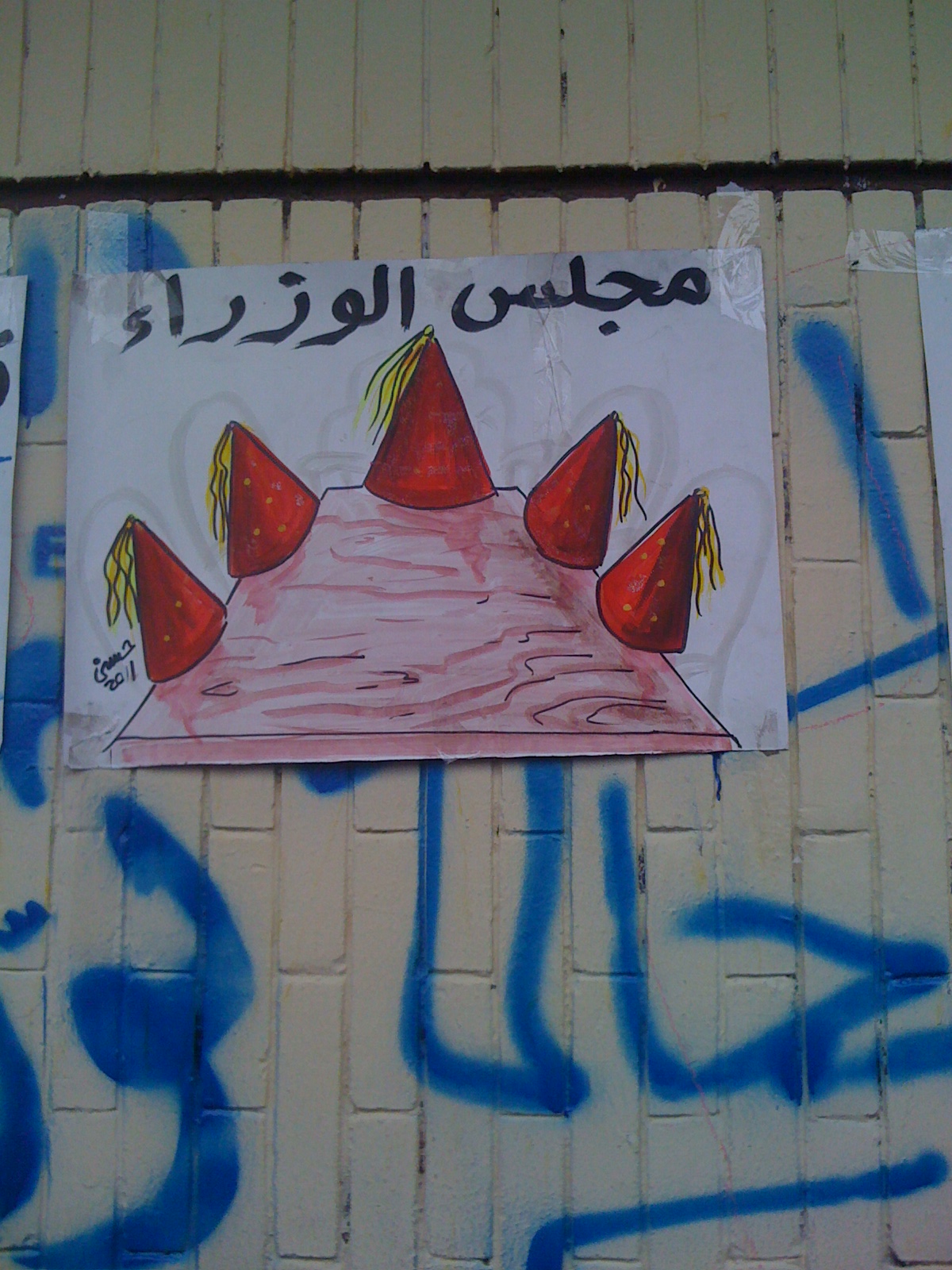
Translation:"The Council of the ministers"
In arabic "tartor" has two meanings 1) a hat worn for a birthday party and (very ammeya [Egyptian colloquial] 2) whipped (someone else has complete control over him).
This cartoon suggests that the ministers are completely controlled by the Council [SCAF.]

Translation: "Communique (#9876543)- the Council [SCAF] is sure that it will not stay in power,
dated 2030."
Many disliked the supra-constitutional principles because they enshrined the role of the military in politics; this cartoon is a spoof off of that fear. SCAF has thus far issued 87 communiques, communique#1 was issued on 10 February 2011 (the day before Mubark stepped down). All communiques are available (in Arabic) on SCAF's Facebook page.

Here is an article reviewing some communiques and how the promises that SCAF made in them have been broken.


The cartoons were taken down before nightfall and the following street art took its place.

Translation: "Down with military rule."
The ventilation window on The Wall has been converted into a prison cell, with a raised fist reaching out.

The following pieces of street are around the corner from The Wall.


Translation: "No mediator"
Several portraits are featured, including those of Field Marshall Tantawi and Alaa Abdel Fattah.


Translation: "Mass-murderer of maspero"
Field Marshall Tantawi is the man depicted as the devil.

Monday, November 14, 2011

The Wall


The Wall is part of a building on the AUC Tahrir campus. (AUC has multiple campuses and satelittle locations in Cairo. The AUC Tahrir campus is the the smaller, original campus of AUC-- the University re-located to New Cairo, an hour bus ride from downtown. The majority of classes are at the AUC new campus). Snipers used this building to attack protesters during the revolution. (http://www.guardian.co.uk/world/2011/sep/15/egyptian-student-protests-american-university-cairo-- an AUC employee argued that he was fired for approaching the AUC administration about the topic). The building is located on the corner of Midan Tahrir and in front of a metro exit so it is very prominent; to this day it remains closed with many broken windows.

I walk by the Wall almost every day and have watched as it was painted on and then painted over. If only Walls could talk.
As I passed it today. I noticed that it had a fresh coat of paint. This is the first coat of paint after the 10/28 demonstrations. Who painted the Wall? And Why? When I walked passed it, it had already been painted-- I pass by the Wall at all hours, but I have never seen anyone painting it white. While it would be easy to think that the police or AUC staff painted over the Wall, let's take a closer look at the timing. There is a major demonstration planned for this Friday (parties from across the spectrum-- including Islamists-- are calling for a million-man march, ) if the SCAF does not revoke its controversial draft of "supra-constitutional principles" by Wednesday.
(The document gives ALOT of power to the military in the drafting of the constitution and future structure of the Egyptian government. The Constitution itself will not be drafted until after the Parliament opens in March 2012--
Could it then have been street artists that painted over the Wall in anticipation of Friday's protest, knowing that they will need a clean slate on which to work?


Not all street art on the AUC perimeter has been painted over. The Wall itself is the most prominent portion of the AUC perimeter, but around the corner a lot of street art remains. I'm not sure when this mural was painted, but it has been here since I arrived in early August and remains untouched (i.e. other artists have respected it and not painted over it).
Translation: "Oh God, My Savior for reform"


Wednesday, November 2, 2011

Alaa Abdel Fattah

UPDATE, 28 November 2011:
Alaa Abdel Fattah's has been transferred to a civilian court and his detention has been extended by 15 days.
http://bikyamasr.com/49824/detention-of-egyptian-blogger-alaa-abdel-fattah-extended-by-civilian-court/

Above are several portraits of Alaa Abdel Fattah in various colors located on a wall of the AUC downtown campus.

Fattah is a prominent political activist. He was sentenced to 15 days in jail after refusing to report to a military prosecution to be questioned about the Maspero events. He does not believe that civilians should be subject to military courts and thus refused to be interrogated by the military. He also does not believe that the military should be investigating the Maspero events because it was the military who allegedly attacked peaceful protesters.

Fattah was jailed for 45 days in 2006 after participating in a peaceful protest. At the time his arrest garnered international attention because it was interpreted as a crackdown on bloggers by the Mubarak regime.

Fattah comes from a family of notable political activists. Fattah and his wife, Manal Hussein, moved to South Africa in 2008 and returned to Egypt during the Revolution.

He and his wife write the well-known blog www.manalaa.net.

Monday, October 31, 2011

Monkey See, Monkey Do


Speak no evil. See no evil. Hear no evil.

Who is the monkey? SCAF or the Egyptian people-- does SCAF want to prevent the Egyptian people from knowing the truth or are the people ignoring it themselves?

This stencil first appeared during the 28 October demonstrations. I have seen 6 or 7 of the stencils around Midan Tahrir, far less than the number of other stencils.

Sunday, October 30, 2011

The Cow


Translation: "The Cow calling haha [name of the cow's owner] and say to my children [the people] haha and the good people with manners, haha, deeply sleeping."
"Al Bukra tnady haha w tkool ya wlady haha w wlad elshoom haha rayheen fe elnoom haha"

The street art is a spoof of the famous Egyptian song "البقرة النطاحة" "Elbkra elntaha" [The Cow who moves his head to hit someone]. The song was a popular refrain during the Revolution. The stencil first appeared during the 28 October demonstrations.

In the song...A man has a cow on which his livelihood depends, but the foreigners stole his cow & all her milk. His cow calls the men with the good manners to come and save her as she's being stolen, but everyone was sleeping. The cow is overwhelmed by her captives and falls into a well in her struggle. "She falls from fear."

Ahmed Fouad Negm wrote this song in 1967 after the "nkba" [catastrophe], i.e. Israeli victory of The Six-Day War in which Israel seized the Sinai Peninsula from Egypt.
In this context: the cow is Sinai Penninsula, those sleeping are the Egyptian military and the foreigners are Israeli.
But who is the cow now? Maybe the revolution is the cow and the Egyptian people are those sleeping while SCAF is the foreigner who is stealing the revolution. If so, how will the cow get out of the well? Will the people of Egypt wake up?


Here are the song's lyrics in Arabic and English.
Here is a Youtube clip of Ahmed Fouad Negm preforming the original song.
http://www.youtube.com/watch?v=ghGSW-K2_m8
Here is a Youtube clip of Azza Balbaa, a famous Egyptian singer, singing the song in MidanTahrir during the Revolution.


Saturday, October 29, 2011

10/28

Demonstrations are a hot spot for street artists. There is usually little police presence and a strong energy.
A large demonstration took place yesterday, 28 October. Since I arrived in August there has only been two other demonstrations which I would describe as "large". 9 September-- the night that the Israeli embassy was burned-- and 30 September. These demonstrations take place in Midan Tahrir on Friday after the Friday prayer. When I say "large demonstration," I am referring to a demonstration that shuts down the entire Midan Tahrir-- Tahrir itself is a large traffic circle. While there are usually demonstrations every Friday-- some of which block of parts of the Midan and cause traffic disruptions, the "large" demonstrations are backed by political parties and movements from across the spectrum, usually with one specific, unifying demand.

Yesterday's demonstration was focused on demanding that the government ban former member of the National Democratic Party (NDP, Mubarak's party) from participating in the upcoming elections.


Translation: "Down with military rule" [yaskoot hokm elaskr]

Military rule refers to the Supreme Council of Armed Forces [SCAF] who took power after Mubark stepped down.

The slogan is a spoof off of one of the popular slogans of the Revolution" "Down with Hosny Mubark" [yaskoot yaskoot Hosny Mubark].